


The Power of Sound: How Hydro Synergy’s Ultrasonic Technology is Transforming Modern Aquaculture Operations

Updated: Nov 9, 2025
Aquaculture New Zealand Conference | Nelson | 8–9 October 2025
What if aquaculture could thrive without depending on chemicals or repeated net cleaning? This question captured attention at the Aquaculture Conference. Alisdair Gribben, Project Director at Hydro Synergy Ltd., presented how ultrasonic technology is reshaping water quality management and algae control in fish farming. The approach is already creating measurable results in salmon farming and finfish aquaculture. It offers a cleaner, safer, and more sustainable path for producers who want to protect both productivity and the environment.
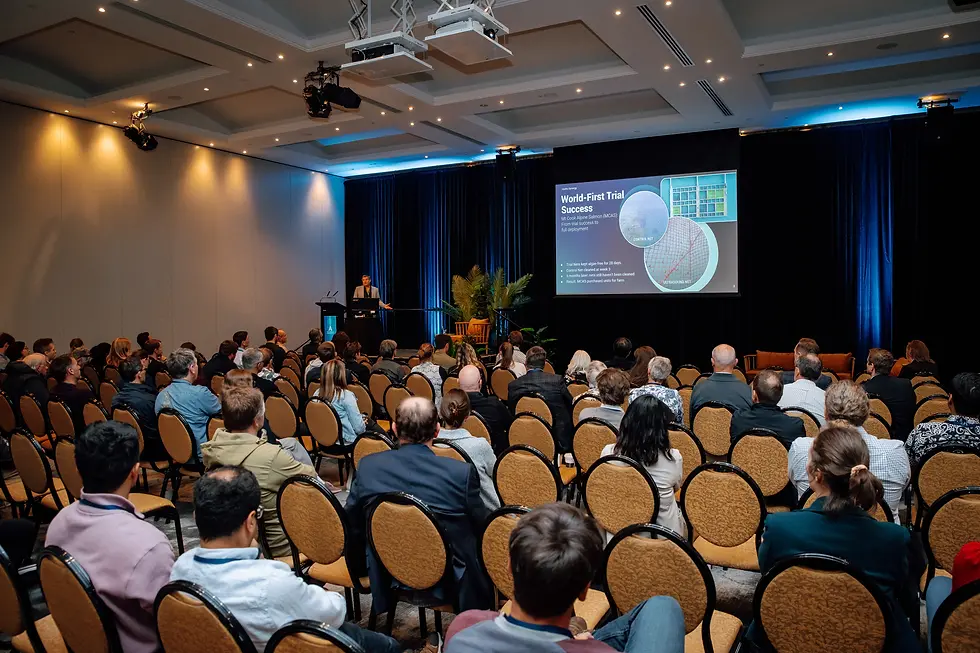
In alignment with the Aquaculture New Zealand Conference 2025, held in Nelson, New Zealand on October 8–9, 2025, industry leaders and innovators gathered to explore sustainable technologies shaping the future of aquaculture. The event was organised by Aquaculture New Zealand Ltd, the national organisation that promotes sustainable seafood production across the country. It featured sessions focused on innovation, environmental performance, and water-quality solutions.
(Learn more on the official Aquaculture New Zealand Conference page)

The Ongoing Challenge of Algae in Aquaculture
Algae control and biofouling continue to present significant challenges for aquaculture operations. They affect water clarity, block nets, and reduce oxygen levels, which can influence fish behaviour and feeding rates. Traditional cleaning methods, such as high-pressure water blasting or remotely operated vehicles, often provide only short-term relief. These methods can fragment algae, causing them to reattach quickly and create new growth. The outcome is increased labour demand, higher operational costs, and unnecessary stress on fish stocks.
Industry leaders have been seeking a reliable and sustainable aquaculture solution. Hydro Synergy’s ultrasonic system answers this need by tackling the source of algae proliferation instead of merely removing the symptoms.
Case Study: Mt. Cook Alpine Salmon – A Turning Point for Aquaculture
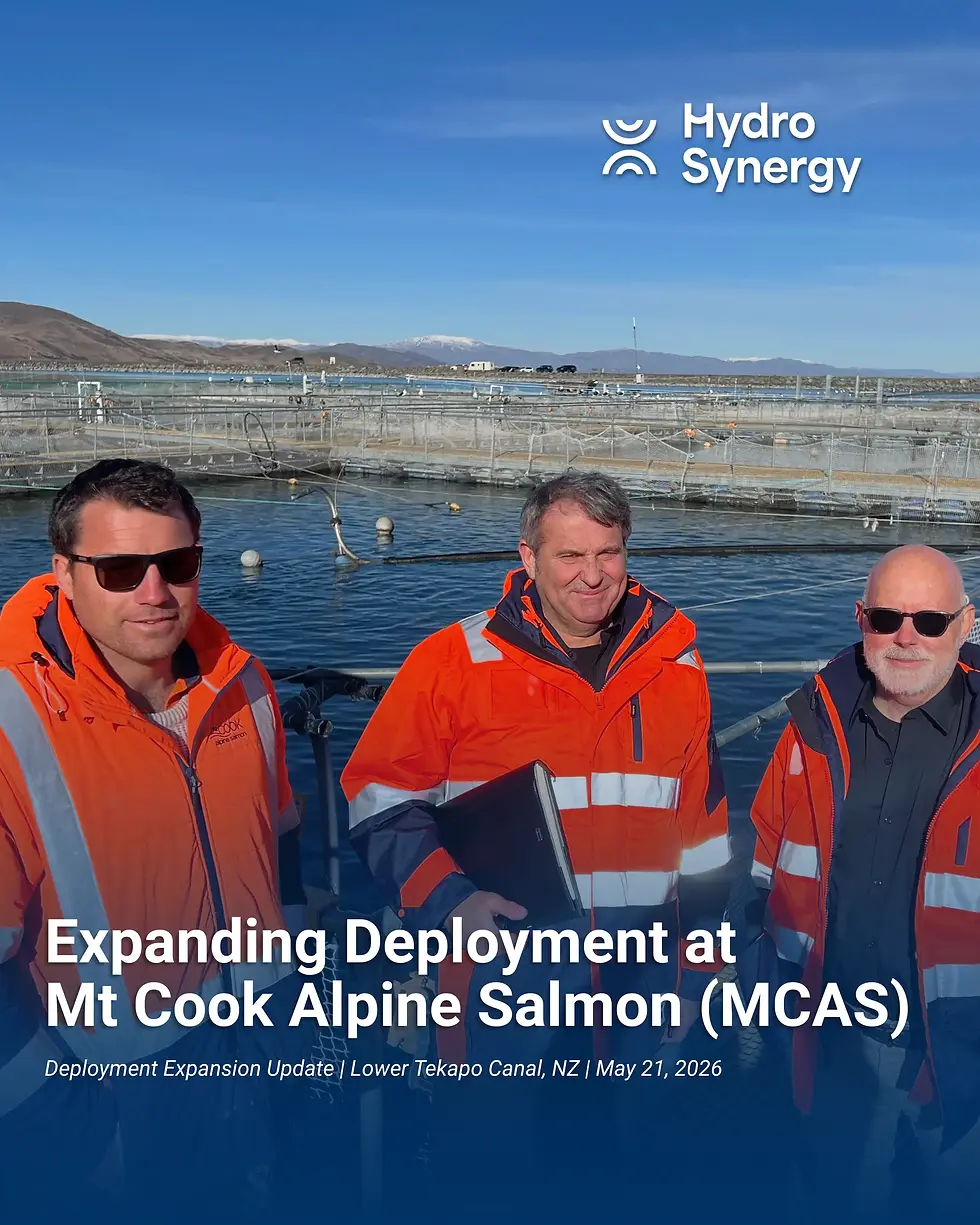
The best demonstration of this innovation took place at Mt. Cook Alpine Salmon (MCAS) in New Zealand’s Mackenzie Country. Hydro Synergy worked closely with MCAS to install its Generation 3 ultrasonic transducers across production nets at the Lower Tekapo Farm. Within 28 days, the nets fitted with Hydro Synergy’s units remained free of algae, while the control nets nearby required cleaning after only three weeks.
These results constituted the world’s first confirmed trial of ultrasonic algae control in commercial salmon farming, verified by Hydro Synergy and MCAS.
Five months later, those treated nets still had not needed another cleaning. This outcome represented a major improvement in maintenance efficiency and fish welfare. The success of the trial led MCAS to adopt the technology across the entire site, setting a new benchmark for sustainable aquaculture in New Zealand.

This real-world case shows how ultrasound algae control can reduce costs and enhance productivity, providing a long-term benefit for salmon and finfish producers.
The Science that Drives Hydro Synergy’s Success
Hydro Synergy’s work is built on a principle called Critical Structural Resonance (CSR). CSR refers to how precise sound frequencies interact with biological structures. Every type of algae has its own natural frequency, and Hydro Synergy’s ultrasonic system emits a wide range of frequencies that target those resonance points. When the emitted sound aligns with the algae’s natural vibration, the internal structure of the cell weakens and stops reproducing.
The latest Generation 3 system produces more than 20,000 unique frequencies between 20 and 250kHz. This improvement gives operators much broader and faster coverage compared with traditional systems. The result is efficient algae control that works quietly in the background without chemicals or physical abrasion.
Ultrasonic algae control technology uses less power than a standard fish-finder sonar and can operate continuously to maintain optimal water conditions. It is safe, energy-efficient, and compatible with existing aquaculture technology infrastructure.
Proven Safety for Fish and the Environment
Fish welfare and environmental integrity remain the top priorities for Hydro Synergy. Independent research conducted in 2022 confirmed that ultrasound of this frequency range causes no harm to fish. Feeding patterns and behaviour were unaffected during extended trials.
The technology creates a balanced aquatic environment that supports both fish health and eco-friendly aquaculture management. By eliminating the need for frequent water blasting or chemical dosing, Hydro Synergy’s system helps farms reduce their carbon footprint and preserve surrounding ecosystems. It represents a significant step towards sustainable water operations that prioritise clean water and long-term resilience.
From Conference Insight to Industry Adoption
The presentation at the Aquaculture New Zealand Conference 2025 drew considerable attention from aquaculture operators, environmental regulators, and research bodies. Many saw the technology as the next stage of progress in the industry. The discussion focused on how ultrasound could become an operational standard for water quality management and biofouling control.
Hydro Synergy’s results are not limited to salmon or finfish production. The same underlying science can support other aquaculture environments where algae and biofouling affect performance. The company encourages farms and researchers to explore how ultrasonic systems could be adapted to their own operations.
A New Standard for Sustainable Water Management
Hydro Synergy’s innovation marks a shift from reactive maintenance to proactive ecosystem management. The combination of acoustic precision, validated research, and proven field performance makes ultrasound one of the most promising tools for the future of sustainable aquaculture.
Cleaner water, healthier fish, and lower costs can coexist through science-driven design. As Hydro Synergy New Zealand continues to refine its ultrasonic technology, it strengthens the industry’s move towards sustainable growth and environmental responsibility.
Innovation in aquaculture begins when science meets sustainability, and Hydro Synergy’s leadership in ultrasonic advancement is showing how that future can be achieved today.
Partner with Hydro Synergy
Hydro Synergy Ltd. is inviting aquaculture leaders, operators, and distributors to explore how ultrasonic algae control can enhance water quality, reduce operating costs, and improve fish welfare across farming systems.
To discuss potential collaboration, distribution, or project opportunities, contact our technical team at:
Together, we can build a cleaner, more sustainable future for global aquaculture.


Comments