


Expanding Deployment at Mt Cook Alpine Salmon

Updated: May 22
Pre-Deployment Update | Lower Tekapo Canal | AC Quattro units | May 21, 2026
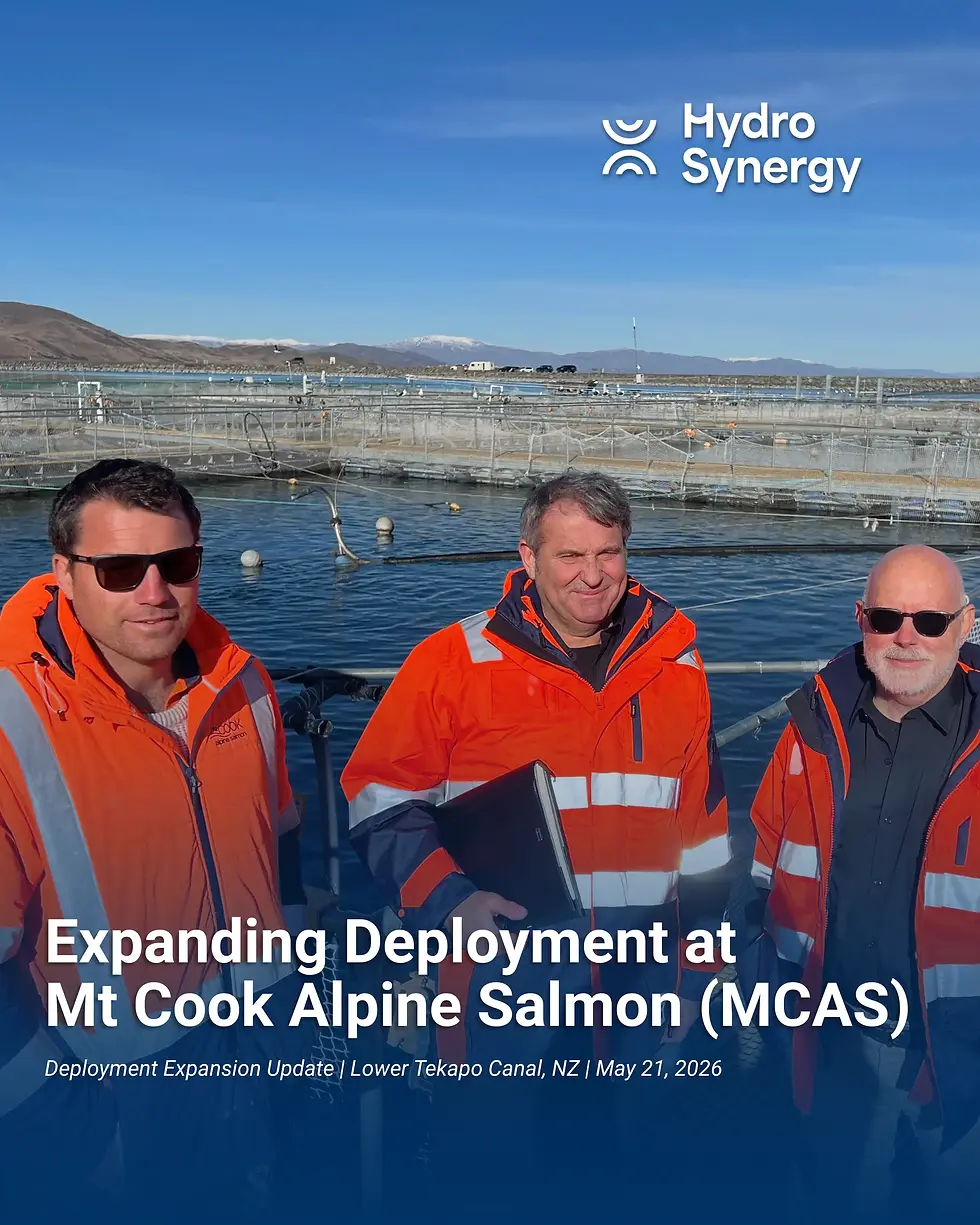
Hydro Synergy is preparing to expand its AC Quattro units deployment footprint at Mt Cook Alpine Salmon (MCAS) in the Lower Tekapo Canal, continuing a commercial aquaculture deployment relationship already operating under real production conditions in New Zealand.
This deployment represents the next stage of an existing field-integrated programme already operating within commercial salmon farming conditions.
Commercial aquaculture operators expand deployment only when systems demonstrate practical value under real operating conditions.
What Was Already in Place
The relationship began around a persistent operational issue: recurring net biofouling accumulation was increasing maintenance pressure across salmon pens, driving cleaning frequency upward, increasing labour demand, and creating operational disruption inside an environment already operating under continuous biological and environmental pressure.
Hydro Synergy’s CSR AC Quattro systems were introduced into the MCAS environment during 2025 to support non-chemical biofouling management and cyanobacteria pressure mitigation under real production conditions.
What followed was not a controlled laboratory outcome or isolated demonstration project. The systems remained in continuous operational use within a working salmon farm environment under the biological, hydraulic, and environmental conditions specific to the Lower Tekapo Canal.
The decision to expand deployment with additional CSR AC Quattro systems reflects what followed operationally: an established commercial operator choosing to extend the deployment footprint of technology already integrated into active production infrastructure.
The Environmental and Operational Pressure Being Managed
The Lower Tekapo Canal is a high-flow alpine-fed freshwater environment. It is highly productive for salmon farming while also presenting persistent biological and operational pressure on the infrastructure supporting those farming activities.
Cyanobacteria pressure develops seasonally and continuously throughout the environment. Biological loading within the water column accumulates across submerged net infrastructure, anchor systems, and structural farming components. Over time, biofouling accumulation restricts water exchange through salmon pen nets, increases maintenance intensity, and contributes to broader operational burden across the production season.
For salmon operators, these pressures are part of normal freshwater farming conditions and require continuous management throughout the production cycle.
Historically, the operational response to these conditions has relied heavily on physical cleaning cycles that are labour-intensive, equipment-intensive, and operationally disruptive.
Hydro Synergy’s role is to provide a non-chemical management layer that works alongside existing farm infrastructure and day-to-day site practices. The objective is to assist operators in reducing biological loading on infrastructure, reducing maintenance burden, supporting operational continuity, and assisting broader water quality management activities without introducing additional chemical dependency into the farming environment.
That is the practical value of field-integrated water quality support inside a working salmon farm.
What This Deployment Represents at the Company Level
The MCAS deployment programme is important not only from a field deployment perspective, but also in how it reflects Hydro Synergy’s broader long-term deployment approach.
Hydro Synergy operates through a Water Quality as a Service (WQaaS) framework.
That matters in how deployments are planned, monitored, and supported after installation. The company is not positioned as a conventional equipment supplier operating through isolated product transactions alone. Nor is it positioned as a consultancy operating independently from field deployment activities.
Hydro Synergy works as an integrated water quality support partner within live commercial production environments, helping operators manage biological pressure, site conditions, and long-term water quality performance.
The relationship extends beyond equipment supply alone. It requires a clear understanding of the site, the production system, and the biological pressures being managed.
WQaaS involves understanding site-specific environmental conditions, infrastructure layouts, operational constraints, seasonal biological pressure cycles, and the realities of maintaining continuous environmental management within live production systems.
It also means ongoing operational engagement after deployment occurs because biological pressure management inside industrial water environments is continuous rather than temporary.
The MCAS deployment expansion reflects what this model looks like operationally: a commercial operator that adopted the technology early, worked alongside Hydro Synergy through sustained operational use, and is now deliberately extending deployment coverage across a larger portion of the production environment.
That is what long-term field-integrated deployment relationships look like in practice.
Why Non-Chemical Operational Management Matters
Commercial salmon farming environments are increasingly operating under stronger environmental, regulatory, operational, and market-driven expectations surrounding chemical use and environmental management practices.
Commercial aquaculture operators are increasingly under pressure to reduce chemical dependency while maintaining stable production conditions and long-term environmental performance.
The result is a broader industry shift toward non-chemical operational management approaches capable of integrating directly into existing infrastructure systems while reducing environmental pressure and operational burden over time.
Hydro Synergy’s deployment model is positioned within this direction.
The CSR AC Quattro deployment systems operate as a non-chemical operational support layer focused on assisting operators with:
Biofouling management across salmon farming infrastructure
Cyanobacteria pressure mitigation
Reduction in maintenance intensity and cleaning frequency
Reduction in labour and operational maintenance burden
Long-term water quality management support
Ongoing environmental infrastructure support within active production environments
For industrial operators, sustainability has to work under field conditions. It must reduce pressure on the site, support production continuity, and fit into existing operational systems without creating new complexity.
The MCAS deployment expansion reflects this broader operational transition already underway across infrastructure sectors.
What Is Being Deployed
The upcoming deployment expands Hydro Synergy’s footprint at MCAS through the addition of 8 CSR AC Quattro units integrated into the existing salmon farming environment.
The deployment is intended to expand operational coverage across the site while supporting broader environmental management and infrastructure maintenance objectives already underway at MCAS.
The deployment is focused on supporting:
Non-chemical biofouling management
Cyanobacteria pressure management
Reduction in maintenance cycles
Reduced operational cleaning burden
Long-term operational water quality support
Long-term water quality and biofouling management across salmon farming operations
This deployment does not replace existing operational systems already in place at the site. Instead, it expands Hydro Synergy’s active environmental management footprint within the broader production environment.
Why Deployment Credibility Matters
Within industrial infrastructure sectors, operational credibility is established through deployment continuity rather than marketing language alone.
Operators need evidence that systems can integrate into real production environments, operate under real environmental pressure, and continue functioning alongside existing operational infrastructure before broader adoption occurs.
This is why repeat deployment activity carries strategic importance. The strongest signals come from operators choosing to expand deployment based on sustained field experience.
MCAS is an active commercial salmon farming operator managing real production infrastructure, biological pressure, maintenance requirements, and operational constraints. The decision to expand Hydro Synergy’s deployment footprint was made following sustained operational use within those real conditions.
That form of deployment continuity and repeat expansion inside an existing commercial environment is the form of credibility that matters within industrial infrastructure sectors.
It demonstrates:
Field integration
Operational practicality
Deployment scalability
Infrastructure compatibility
Long-term operational relevance
For Hydro Synergy, the MCAS programme reflects the broader pathway the company is building: field-integrated deployments that continue through practical performance, not speculative positioning.
Operational Implications for the Broader Sector
The environmental and operational pressures being managed at MCAS are not unique to the Lower Tekapo Canal environment.
They reflect broader challenges increasingly faced across commercial aquaculture and industrial water infrastructure sectors globally:
Increasing environmental management expectations
Rising scrutiny surrounding chemical dependency
Labour and maintenance resource constraints
Increasing operational pressure on infrastructure systems
The growing need for scalable environmental management frameworks integrated directly into production operations
The case for non-chemical, infrastructure-integrated water quality management is no longer theoretical.
It is already being implemented inside real production environments by operators making practical operational decisions about how environmental management will function over the long term.
The MCAS deployment expansion is one example of how non-chemical water quality management is moving from trial discussion into practical field use.
Closing
Hydro Synergy’s work at Mt Cook Alpine Salmon reflects an operational principle guiding every deployment activity undertaken by the company:
Water quality infrastructure earns trust through continuous field performance inside working commercial environments.
The deployment expansion at the Lower Tekapo Canal is therefore not positioned as a future aspiration or theoretical environmental concept.
It is the continuation of an operational relationship already functioning inside an active commercial salmon farming environment.
That is what long-term field-integrated deployment looks like in practice. That is the deployment model Hydro Synergy continues building across commercial aquaculture and industrial water environments.
Hydro Synergy · www.hydrosynergy.co.nz · 0800 662 5423 · support@hydrosynergy.co.nz
Hydro Synergy | Water Quality as a Service (WQaaS)
Operating across commercial aquaculture, industrial water quality, and environmental infrastructure management in New Zealand and international markets.


Comments