


Key Insights from Ric Church at the 2025 Water NZ Conference

IWA-ASPIRE and NZ Water Conference & Expo 2025 | Christchurch | Sept. 30 - Oct. 3, 2025
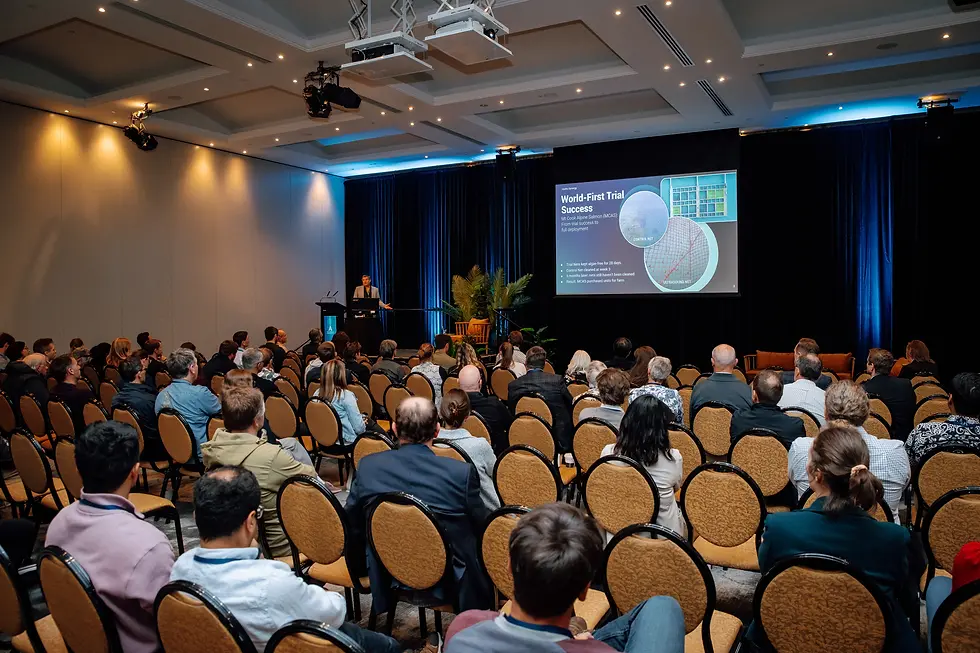
At the 2025 Water NZ Conference, Hydro Synergy Ltd. CEO Ric Church presented a data-driven overview of how ultrasonic algal management is supporting councils and operators facing difficult algal bloom conditions across New Zealand. His talk centred on field outcomes rather than theory, offering practical visibility into what has worked in real deployments and why certain water bodies respond the way they do.

Ric emphasised that councils and environmental teams increasingly require solutions that are effective, measurable, and aligned with long-term sustainable water management expectations. His presentation provided a clear look at how ultrasonic tools can integrate into that pathway without escalating chemical load or operational risk.
A Crisis at Lake Tewa
One of the most urgent examples Ric discussed was the rapid deterioration of Lake Tewa, where cyanobacteria levels surged to 25 million cells per millilitre, pushing the lake into a severe algal bloom state. Visibility collapsed, scum formed on the surface, and the lake entered red-alert conditions. Chemical treatment had already been applied, yet the site continued to worsen.

Ric explained that this scenario required a fast intervention capable of reducing cyanobacteria without adding more chemical pressure. Hydro Synergy deployed ultrasonic algal management under urgency, with the aim of supporting a reduction in bloom activity and lowering immediate risk.
A Rapid Turnaround in Six Days
Ric presented confirmed monitoring data showing that cyanobacteria levels dropped from 25 million cells/mL to 8,200 cells/mL in six days following ultrasonic deployment. Within one month, the lake was visually clear. Alongside the reduction in cyanobacteria, the site showed a significant shift in water quality indicators, including a correction in pH from 9.2 to 7.2.
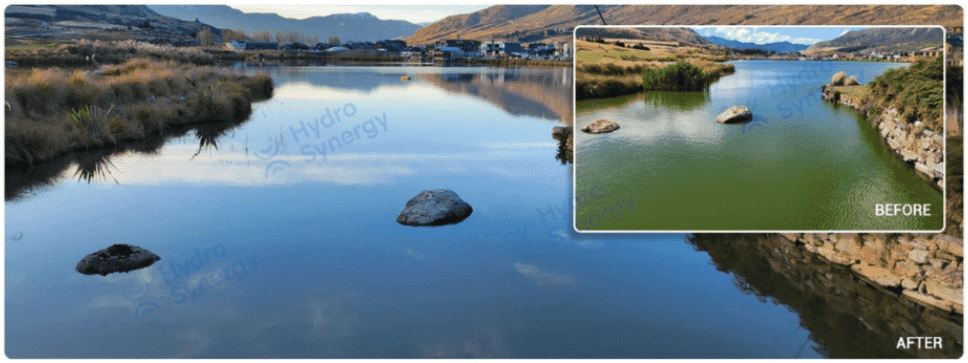
These results demonstrated how targeted cyanobacteria reduction can support improved conditions when traditional methods have reached their limits. Importantly, Ric highlighted that the approach provided an immediate pathway to stabilisation without increasing chemical input.
Field Results in Aquaculture: The MCAS Deployment
Ric also shared verified outcomes from an aquaculture deployment at MCAS. Four pens, each approximately 20 metres in diameter, had accumulated heavy filamentous net fouling. After ultrasonic installation, fouling began to collapse, clearing progressively over several weeks. By day 28, the nets were visibly clean.

The most notable insight was that the nets remained clean for five months, despite ongoing fouling pressure. Ric described this as a first for that environment and highlighted how this level of consistency supports operational planning and reduces reliance on reactive cleaning cycles.
These results reinforced the potential of aquaculture fouling mitigation using non-chemical tools, especially in high-density farming conditions where water movement and maintenance cycles are closely linked.
A Broader Direction for NZ Water Management
Throughout the talk, Ric emphasised that sustainable approaches must work with existing systems rather than around them. He linked the Lake Tewa and MCAS outcomes back to broader expectations under New Zealand’s environmental and regulatory frameworks, noting that:
reducing bloom activity supports lower chlorophyll-a
lower chlorophyll-a contributes to improved trophic level index
ultrasonic tools offer a scalable, non-chemical pathway
consistent monitoring is crucial for decision-making
These points positioned ultrasonic algal management as an approach that can be incorporated into established operational and compliance processes, rather than as a replacement for existing frameworks.
A Practical Message to Decision-Makers
Ric closed with a practical call to evaluate sustainable tools that can:
reduce escalating interventions
support more stable environmental conditions
improve recovery pathways in high-risk sites
His presentation highlighted that sustainable water management is not just a policy requirement but an operational necessity as environmental pressures intensify.
For councils, utilities, and operators seeking realistic, scalable options for managing bloom-prone environments, Ric’s talk provided a clear and evidence-based view of what ultrasonic tools have achieved in New Zealand conditions and how they can be applied with measurable impact.
Partner with Hydro Synergy
Hydro Synergy Ltd. is inviting councils, water operators, environmental managers, and industry innovators to explore how ultrasonic algal management can support safer water conditions, reduce operational burdens, and strengthen long-term water-quality outcomes.
To discuss potential collaboration, field trials, or project opportunities, contact our technical team at:
Together, we can help shape a cleaner, more resilient future for New Zealand’s waterways.
Comments